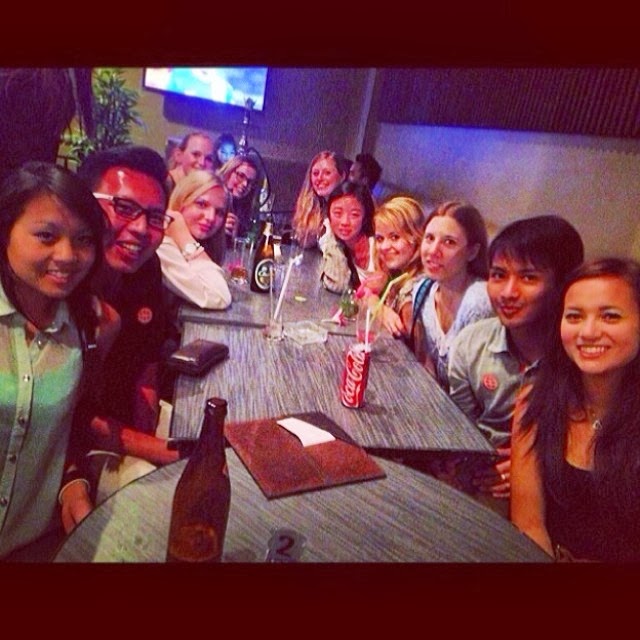
Thursday, 17 April 2014


This week Joshua stepped outside Thailand and discovered 2 hidden gems of South East Asia: Ho Chi Minh City and Vientiane. This is also one of the benefits of going on a Grand Tour. A chance to visit neighboring countries within easy reach J

The Gems of South East Asia

Having been blessed with another “Study Week” (if you are not familiar with this term, please refer to my previous writing J) just one week before the exam week, I made the best out of it by travelling to Thailand’s neighbouring countries, Vietnam and Laos respectively. One adjective to describe both countries would be “forgotten” since they have not been popular tourist destinations yet unlike Thailand, Malaysia or Singapore even though Vietnam is now emerging as another Southeast Asian’s power. Well, let me tell you my stories then!

Ho Chi Minh City, Vietnam

Ho Chi Minh City
Formerly known as Saigon, this bustling used-to-be capital of South Vietnam is the largest urban area in the country that looks like an elongated “S”. Having spent a weekend there is probably not enough to explore the city and its nearby tourist attractions, such as Cu Chi Tunnel. Along with my Vietnamese friend/travel buddy called Mai, she took me around her melting-pot city by her scooter. By saying scooter, I really mean there are probably zillions of motorcycles. Just to warn you before visiting this city is to prepare yourself for the insanely crazy traffic. I really mean it as you should not expect the traffic to stop just because you would like to get across the road. 

Besides the traffic, I would say that HCMC (Ho Chi Minh City in short) is amazing! Not only because of its local food (since I love culinary travelling), but also because of its rich, a bit gloomy history due to French and US’ invasion as well as the civil war. Since I am not good in history, it may be better if you browse Mr. Google or Miss Wikipedia for further information :p

The Independence PalaceAt first, I would expect the country to be “same-same” like other Indochina countries, but the city, apparently, still maintains strong influences of its former occupiers especially in terms of the architecture, which portrays the influence of French colonial style. Besides various museums and historical monuments (such as Independence Palace), HCMC has a lot to offer! Starting from the highest skyscraper in the city – Bitexco Financial Tower – with the resemblance of Vietnam’s national Lotus flower to Saigon river to spend your evening while sipping a sunset cocktail in one of the riverside restaurants. Otherwise, take an evening walk along the main avenue in District 1 where many branded shopping malls are located.

The Pink ChurchWhat make the city even more interesting, surprisingly, are the churches. Along my trip, I have seen so many churches with unconventional European design. One of them is even flashy pink in colour! However, Notre Dame Cathedral is probably the most famous one that attracts a lot of tourists and locals alike due to its central location in District 1 nearby other popular spots as well, such as the Central Post Office.

One last note that I have never experienced it before was Saigon backpacker’s nightlife. Mai brought me to a local street where a plenty of foreigners and Vietnamese youngsters sit down on the pavement, having a nice chat while savouring Saigon’s local beers. That was just so fun especially when you gather with your friends and start jamming or singing along.

Sabaidee! Vientiane, Lao PDR

Pha That Luang
Laos or officially Lao People’s Democratic Republic (Lao PDR) is probably the “forgotten” gem of Southeast Asia as it is still untouched in the world of tourism. The only landlocked nation in ASEAN, Lao PDR boasts about Mekong River that has nourished the country since ages. Nonetheless, my super short trip, in the capital namely Vientiane, is definitely worthy. This time, I travelled by myself from Monday night until Thursday morning on a sleeper night train from Rangsit to Nong Khai (where it borders with Lao via Thai-Lao Friendship Bridge). Albeit such a short period, but I have successfully managed to visit at least, all tourist destinations recommended in its official tourism website.

In general, Lao is pretty much similar to Thailand particularly in terms of language, culture and food. As it used to be a French Indochina colony too like Vietnam, the legacy of French-style colonial buildings is still present up to date. In short, I can say that Vientiane is like a combination of Thailand and Vietnam as they share similar history.

Patuxay
What I really enjoy from my trip in Vientiane was going to Patuxay. A local rendition of Arc de Triomphe of Paris, Patuxay is a gigantic, gate-like monument that is just located in Lane Xang Avenue, one of the main streets of Vientiane. Facing a classic French-style Presidential Palace at the other end of the avenue, you can see the panorama from the top of this building. One more thing that makes it unique is the presence of the World Peace Gong, a gift from Indonesian World Peace Committee to Lao PDR Government. The Indonesian Embassy is even within a short walking distance from this park.

At last but not least, I would say that Vientiane is really a “walk-able” city as there is less congestion and proper traffic light system. In addition, most of tourist attractions are located in the city centre so you can just walk around like I did. The city layout and organisation is very clear so it is very convenient to travel solo on foot. If you would like to immense more in the cultures, I think Luang Phrabang (an 8-hour road trip from Vientiane) on the north has more to offer especially if you enjoy seeing the temples. Why should you wait? Be a jet setter that discovers and unravels the beauty/mystery of the country!

The World Peace Gong


Friday, 4 April 2014


If you love spicy food and happen to be in Thailand, chances are, you would try as much local spicy food as you can while you are there. This week, Joshua went on to more culinary trip, and this time he got the chance to dine at Asia’s Number 1 Restaurant!

Wanna be on Top?

Minced prawn simmered with shallots, young chillies and coriander
Quoting from America’s Next Top Model (ANTM) theme song hosted by Tyra Banks: “You wanna be on top?”, I finally got a chance to dine out at Asia’s Number 1 Restaurant/Top 32 World’s Best Restaurant called Nahm. Awarded by Restaurant Magazine – a UK’s industry publication – Nahm is headed by an Australian-born Executive Chef, David Thompson, who earned the first Michelin star for Thai cuisine. As for my friend and I, like we always say: “To see and to be seen”, this dining experience can just perfectly describe this saying. My friends and I booked a table for 4 two weeks before our visit. I am presenting you: Thai Gastronomy Part 2. 

Strategically located on one of the high-end, busy streets of Bangkok, Silom Road, Nahm is a humble Thai restaurant inside a luxurious hotel; Metropolitan by Como. Why did I even write “humble” when all the signs indicate that this restaurant is anything but that? There is no barrage of signs in the area indicating that in the area lies ‘Asia’s Number 1 Restaurant’. The restaurant relies solely on its performance to woo everyone away.  Anyways, check out what I ordered during my visit here!

Soft shell crab stir-fried with chilies
After a state of indecisiveness commonly known as galau by Indonesians whether to choose set menu or à la carte, we finally decided on four different dishes and two desserts to be shared. Again, collectivism! Well, since pictures paint a thousand words, I guess it is not necessary for me to describe how ‘delish’ and gorgeous every dish was presented and served.

For me, the highlight dish of the day was soft shell crab stir-fried with chillies, holy basil and green peppercorns. It was truly ‘flavourful’ with amazing blends of spices. If I were a TripAdvisor rater, I would say that this dish is HIGHLY RECOMMENDED! 

Besides, its minced prawn simmered with shallots, young chillies and coriander fresh vegetables and smoked pork was highly acclaimed as one of Nahm’s signature dishes too.

Pandanus noodle with black sticky rice
My other favourite would be one of the desserts; Pandanus noodles with black sticky rice, water chestnuts, tapioca and coconut cream. What an exquisite sweet treat to end my palate’s gastronomic experience! Although it is similar to an Indonesian-style dessert, which may be due to typical ingredients used such as coconut cream or pandanus noodles, I was hypnotised by the combination the Chef has made for this treat. At the end of the day, my appetite was satisfied.

To end with, let me give you a few tips before coming to Nahm. First and probably, the most important one is to RESERVE your table, at least one week prior to your anticipated visit. I am pretty sure that walk-in is hardly accepted even on weekdays due to its popularity among expatriates. Moreover, do not expect this place to be able to accommodate more than hundreds guests. In fact, this restaurant is relatively small, which surely enhances the intimacy and privacy for each party. Last but not least, if you are not a spicy food-lover, then this place offers very little. Why so? It is because Nahm takes pride in its spices.  Nevertheless, in order to get such high-end dining experience, be prepared to spend at least THB 1,000++ per person.

Plum in scented syrup with Thai cupcakes

‘There is no love sincerer than the love of the food.’ Have a nice day!

Friday, 28 March 2014


Although called the Study Week, where students are given some time off to have individual/group study to prepare for exams, many of them take this opportunity to travel instead! Our fellow Grand Tour student, Joshua is also going on an adventure to visit the popular tourism destinations (and see cabaret live show) in Thailand.

The Irony of Study Week

My favourite spot, Maya Bay on Koh Phi Phi Islands
Study Week? At first, it REALLY sounds boring and probably as terrifying as when you hear the word “Exam Week”. Contrary to what you may initially expect, for me (as a Stenden student), we always wait for this week to come soon and embrace it cheerfully in every term/Module J. Why so? Because this week is my “Study Week”, in other words, a one-week off from Rangsit University. Of course, all of us, the Grand Tour students, make use of this opportunity to travel to different parts of Thailand. Island hopping is probably what most Grand Tour students do starting from Koh Pha Ngan for its famous full moon party held once every month to Koh Phi Phi where one of DiCaprio’s movie in 2000 called The Beach was filmed. 

As I have spent my entire life in the Indonesian archipelago, I decided to spend half of my Study Week back to my lovely home city, Jakarta! Besides staying with my family, I also got the chance to explore a lot of hip and trendy places, such as The Cloud Lounge & Living Room, a rooftop bar on the 49th floor overviewing Central Jakarta. Enough said about my trip back to Jakarta and now let’s get back to my Thai adventure.

Located in the Andaman Sea of southern Thailand, Phuket is an island as well as a province with tourism as its main income. As I began to disembark from the aircraft, I was welcomed by a long queue in the Immigration at Phuket International Airport. In addition, the mid-day heat took me by surprise as I stepped out of the building. Even so, I would say that my short, weekend getaway to Phuket Island was worthwhile.

Bangla Road

I stayed at Phuket’s equivalent to Kuta Beach called Patong, and I must confess that this island is breathtakingly beautiful. Considering that this was a short trip, my friend and I did not waste our time, and thus started our endless spress of sightseeing activities.

The three highlights of my trip are Bangla Road, Koh Phi Phi islands hopping and Simon Cabaret Show. At the heart of Patong district, Bangla Road is the perfect place for the nocturnal partygoers on the island. Along the road where no vehicle is allowed to pass, there are different kinds of Thailand’s nightlife entertainment, such as restaurants, bars, pubs, strip clubs or even “ping-pong” shows. Although I did not stay for a long time here, my night promenade was awesome seeing the bustling nightlife of Phuket.

I believe, Koh Phi Phi islands hopping is a must in your agenda when visiting Phuket. An hour away by chartered speedboat from eastern Phuket’s pier, you will be relaxed by the breeze, azure of Andaman Sea and tropical coral reefs. Whether you would like to snorkel, swim or just sunbath, this day excursion has something for everyone. One spot that I enjoyed so was Maya Bay where The Beach’s shoot took place.

Simon Cabaret Show
At last but definitely not the least is Simon Cabaret Show. What else can you expect from a typical Thai entertainment? Surely, a cabaret show performed by the most gorgeous, good-looking ladyboys of Thailand, known as the otherwise transvestites of Thai. Recommended by all Phuket’s tour operators, Simon Cabaret Show will pamper you with an amusing dance performance from different cultures and eras for approximately 1 hour and 15 minutes in its state-of-art theatre with great lightings and audio. Taking picture with the ladyboy before or after the show is also another unique experience although you are expected to give 100 Baht as tip”. Nonetheless, I really enjoy their performances especially in terms of their choreography and costumes.

Well, was there anything new that I have learned from my trip to the southern part of Thailand? The answer is Yes! Apparently, in Phuket for instance, there is a proportional percentage of Thai Muslims in the society. This fact answers my initial doubt when passing a number of mosques along the way from the airport to Patong area. One of the local tour guides also told me that there is an increasing percentage of Thai Hindu due to the influence of Indian diaspora here. Interestingly, I met several Thai people who could speak Malay too, which I rarely see in Bangkok. This may be due to Malaysia’s influence on the Southernmost provinces of Thailand.

A hint for my next writing, it is another Thailand’s Gastronomy Part 2 as I am going to feature Asia’s No. 1 Restaurant. So, stay tuned and get back to work (and the real studies)!


Friday, 21 March 2014


At Stenden, students get the chance to learn Spanish as second foreign language. Joshua has been very busy practicing Spanish this week and in this edition he is sharing his presentation video on Alila Villas Uluwatu in...Spanish! Check it out!

Habla Español?

A night out with fellow students
Hola! Cómo están? These are just some daily Spanish phrases to say: Hi! How are you? Well, this week (Week 6) is somewhat very exciting, yet challenging at the same time. It is exciting because it is my last week before my one-week off commonly called as “Study Week”. Besides, as I mentioned in my previous writing, I have two oral assessments in Spanish, which are a sales presentation and a role-play. Gladly, by the time this writing is posted, I hope that I did quite well for these two assessments.

I also would like to use this opportunity to thank Ms Helen Pardo, my Madridian, Spanish teacher, who taught my class intensively since 6 weeks ago. Without her patience, support and continuous guidance, I do not think that my Spanish skills could improve significantly. I also wish her the best and success in her career, as she will attend a conference in Europe for the next 2 weeks. 

To be honest, as I was (diligently) practicing my scripts for both the presentation and role-play, I had less chance to do new leisure activities compared to the previous weeks. Even so, on Tuesday, I went to a cinema for the first time in Thailand with my classmates to catch a movie in 3D, 300: Rise of an Empire.

Major Cineplex – as what the cinema is called – is probably the nearest entertainment complex from Rangsit University. Interestingly, there is something unique when you watch a movie in Thailand that even you will probably not experience this anywhere else. Guess what, before the start of every movie, everyone in the theatre must stand up, while Thai Royal Anthem is being played. After the anthem, one has to take a bow to show respect for the King. I was amused and awed witnessing how Thai people adore their royal family especially His Majesty King Bhumibol Adulyadej, the current monarch of Thailand.

Then, the movie proceeds afterwards. Another interesting fact about watching a movie in Thailand is no scene or segment of the movie that is cut or censored even though it is gruesome or explicit. This is what my Thai friend, Pook, told me.

What else can I say about this week besides the last week of having my last Spanish classes? I have gained so much knowledge, not only about the language itself, but also about the culture of Spanish-speaking countries. Sometimes, my classmates and I are treated with visual illustrations through YouTube videos or images related to the cultures, such as Spanish movies and typical dishes. Indirectly, we gain a clearer picture of these things instead of just imagining ourselves from the textbook.


For your additional information, my Spanish sales presentation is actually about Alila Villas Uluwatu, one of Stenden’s strategic hotel partners, which you can find it here! Please comment and leave your feedback J After my presentation, I received positive feedback from my teacher as well as my classmates that even they would really love to go to Bali and stay there. It gave me great pleasure and satisfaction that I could present, at least, a glimpse of Bali’s beauty to the others who have never been there. As the only Indonesian in the group (also among the Grand Tour students), I am so proud that I could represent my country to promote Indonesia’s tourism. In fact, some of them are highly interested in travelling to Indonesia, including my Thai buddies. 

At last but not least, I would like to extend my best wishes to my fellow colleagues in Stenden University Bali that are doing their oral assessments this week! Wish you luck and success!
  

Thursday, 13 March 2014


Thailand is famous for its tasty and spicy cuisine. Follow Joshua’s journey of savouring the richness of Thai delicious dishes (in his spare time while preparing for assignmentsJ).

The Gastronomy 1: Bringing Thai Cuisine to the Next Level

Nahm Mao, Bo.lan restaurant's signature cocktail
Time flies. For me, this idiom is so true since I cannot believe it is halfway through my Grand Tour experience in Thailand. Of course, there are many things going on now, such as my final presentation and role-play in Spanish.

Anyway, although the preparation for these two assessments takes so much time and efforts, it does not stop me from what I truly like; FOOD TRAVELLING! Last Saturday (which apparently was International Women’s Day too), my friend and I embarked upon a gastronomic journey to the centre of “The Big Mango”, none other than Bangkok.

Voted as No. 28 of Asia’s Top 50 Restaurant 2014, Bo.lan Thai restaurant is wholeheartedly ready to serve you with an authentic Thai dining experience. Nestled in the bustling, vibrant Sukhumvit district, this restaurant is just superb in terms of quality, atmosphere as well as service.

Having decided for an a la carte menu, I ordered Bo.lan Nahm Mao as the aperitif. Mao, in Thai, literally means drunk. I was a little bit tipsy somehow even though the sweetness of palm nectar, warmness of ginger and aromatic of lemongrass balanced strong alcohol contained. A nice treat to start!

Are you ready for the full version of a mouth-watering experience? First up was a bowl of soup called dhom gati nua nong, which is coconut-based soup of salted “KU” beef shank and pickled bamboo shoot (THB 320++). It was muy delicioso (take some Spanish phrases that I have learnt ^_^) although it was a little bit too spicy for us. Perhaps, this was the lowest spiciness level for a typical Thai cuisine.

Dhom gati nua nong (coconut based soup of salted KU beef shank and pickled bamboo shoot
Main courses to be shared? Yes, we are not going Dutch, meaning that we did not order for individual dishes, but instead two main courses to be shared. Since we were in a Thai fine-dining restaurant, we embraced Thai’s collectivism culture in dining. Finally, we fell in with the same decision to order called pad pla muk kai kaem (THB 520++) and geang gai sai yuak guai (THB 620++). In translation, they refer to stir-fried Ranong squid with Chaiya salted duck egg and southern-style red curry of organic chicken from Phang-gna with banana heart respectively. They were not that spicy compared to the previous soup since we have said “mai ped” to the waiter, which means “not spicy”. Crafted lovingly in a chic plate presentation along with tasty flavours is probably the best balance of a proper dish for one to savour. Similar to Indonesian cuisine, what I can say about Thai food is its richness in spices and herbs that produce a lot of flavours, textures and aromas.

What else can you expect from a fine-dining restaurant? For me, it should have an awesome finishing touch to the whole dining experience, the desserts! Again, my friend and I agreed to the same thing, which is young lotus seed served with purple yam dumpling with young coconut simmered in coconut cream (THB 320++). It looked very simple as this warm dessert was mainly made from coconut. However, the taste was simply stunning combined with a soft texture of a creamy-like pure coconut pudding. This just made my day after such a long day trip! 

Overall, I would highly recommend this restaurant when you travel to Bangkok. It is worth to try! If I were given a chance to rate this restaurant, I would say 8 out of 10 by taking the three aspects of food quality, atmosphere and service into consideration. Make sure you make a reservation in advance (a couple days before your arrival is preferable) due to limited space and high demand especially from the tourists.

Lastly, wish me luck for my Spanish presentation and role-play this week! I really hope that I could pass with flying colours. Keep following my blog, as I will feature more food recommendations in the future!  
  

Wednesday, 5 March 2014


The Temple of Emerald Buddha

Week 4 already and our fellow student, Joshua, is almost halfway on his Grand Tour journey in Thailand. He has made friends with local and international students. He noticed that the Thai people often referred the international students who come from Western countries as “farangs”. After talking to his Thai friends, Max and Little, he came to understand that the term does not mean to be offensive and that the presence of “farangs” in the country is seen as a positive thing.


Farangs VS Thais

First thing that probably pops up in your mind: What the heck is “farang” (or "farangs" in plural)? Another lesson learnt this week, this term is none other than “bule”, a term commonly used in Indonesia. Similarly, “bule” can also be interpreted as foreigners especially white people. Is the usage of this word offensive? Even though it is controversial, it is generally accepted in the local community. Just to give you a little bit of what “farang” is perceived in Thailand, here is the definition by Urban Dictionary:

‘Thai word for white people or Westerners, generically referring to non-asians. Generally used without derogatory connotation, derived from the Thai word "farangsayt" for French.’ 

To be honest, I do not want to ignite a racist clash because of this title. I think it is interesting to bring this topic up, as this week’s blog will feature two of my Thai buddies, Max and Little. Not to mention that they are my mobile Google to get an insight into Thai cultures, but also I am curious to know how they perceive the influx of foreigners in their country including us, the Grand Tour students. Thus, this is how my casual interview with both of them goes.

Socializing with "farang" and local students. Max is second from right.

A 21-year-old Max who was born to a Lao father and a Thai mother is currently a second-year student in the Faculty of Business Administration at Rangsit University. He is my first Thai friend that I met from the previous Buffalo Village field trip last week. Since then, I have spent more time with him having dinner together as well as introduced him to my fellow Grand Tour colleagues. Originally from a rural area near Thailand and Laos’ border, check out his response below regarding the issue of “farang”: 

Q: What do you think about the presence of foreigners/”farangs” in your country?
A: I am thankful that many foreigners come to Thailand. It is a positive thing. We (refer to Thai people) are very welcome to foreigners because we can share our cultures and learn new languages as well. I also learn a lot from you to improve my English skills.

Q: So, what does “farang” mean for you?
A: Well, “farang” is a Thai word that only refers to western people. It sounds similar to the word “foreigner”, but since it is difficult for Thai people to pronounce, it is then a habit to call foreigners as “farang”. I would say that it is not rude at all. Interestingly, the word “farang” itself also literally means guava as the fruit in Thai language. 

Q: Are you used to seeing “farangs” in your hometown, for example or rural areas?
A: I saw them also in my hometown. In fact, there are many women who get married with older “farangs” because many people believe that they will be rich. Many of us think that “farangs” are rich. That is the reason so many “farangs”, even in the rural areas, get married to local women.

A picture of Little I took while having a nice conversation about "farang" over ice cream :)

A 2nd year Thai girl from the Faculty of Liberal Arts majoring in English, Little, as the name suggests, is my little friend with a big heart as she is very nice and helpful. Born and raised in Bangkok, Little is proud of studying at Rangsit University because of these reasons!

Q: How do you feel studying at Rangsit University?
A: I think Rangsit University is the best university for me because it is very famous in Thailand and you can get a good job after you graduate. Rangsit University has set high standards of education and teaches us invaluable lessons of practical corporate life which would help us in the future.

Q: What do you think about the exchange programmes at Rangsit University? Do you like more foreign students to come here?
A: Yes, of course. I think the idea of students exchange is a good idea to know more about other people’s cultures from various backgrounds. This makes me curious. Besides, I can be a more open-minded person that is able to handle different intercultural situations. Even though I am shy at first, but I am trying to communicate in English to be better.

To sum up, Thai people are, in general, very welcome towards foreigners and different cultures. In Rangsit University, for example, many of the local students are eager to learn from different nationalities and various cultures, including me myself too. For me, it may not be too obvious that I am a foreigner since I look like Thai. For the other Grand Tours, I believe that they are not offended when someone calls them “farangs” due to their “sabai-sabai”, which means chillax in Thai.

Karma, a teaching from the Buddha
So far, I have not experienced or at least, noticed any resentment against “farangs” in Thailand, but it may be interesting to know that there must be someone in the society that dislikes the presence of “farangs”. Even so, just like what karma teaches us, if your deed is bad then you must pay for it. That is why it is important for me as a Grand Tour student in Thailand to pay respect to the local customs and adapt to them in order to avoid any trouble.

Lastly, thank you very much my buddies, Max and Little! If you would like to connect with them, add them as your friends on Facebook above J